
Create a Advanced Flow
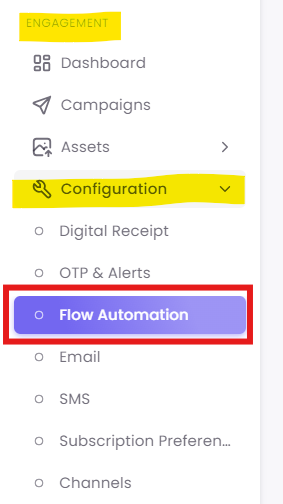
Step 1: Navigate to Flow Automation
Step 2: Create a New Advanced Flow
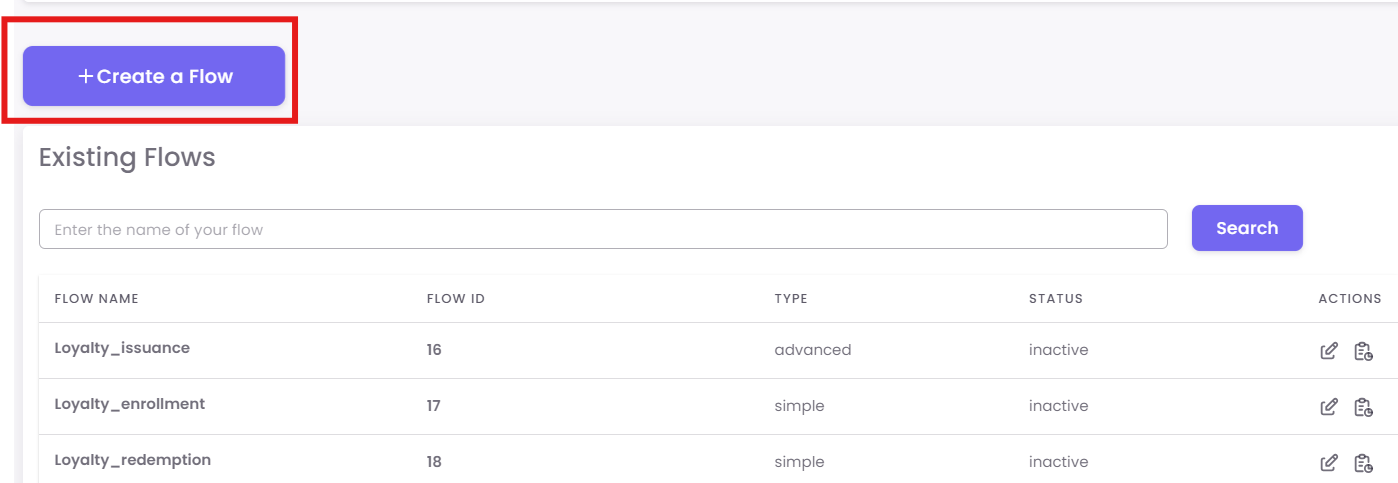
In the "Existing Flows" dashboard, click the + Create a Flow button.
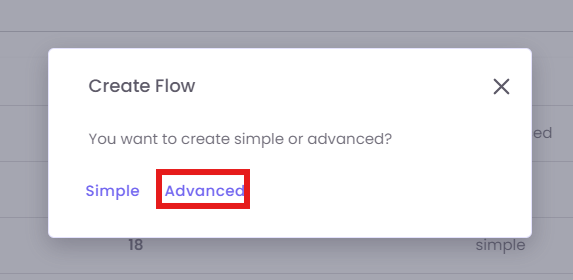
A pop-up will ask you to choose the type. Select Advanced.
Step 3: Select Your Trigger
You will now see the blank canvas. Your first step is to choose the event that will start this flow.
-
On the "Nodes" panel (left), make sure you are on the Triggers tab.
-
Drag your desired trigger onto the canvas. This will be step0.
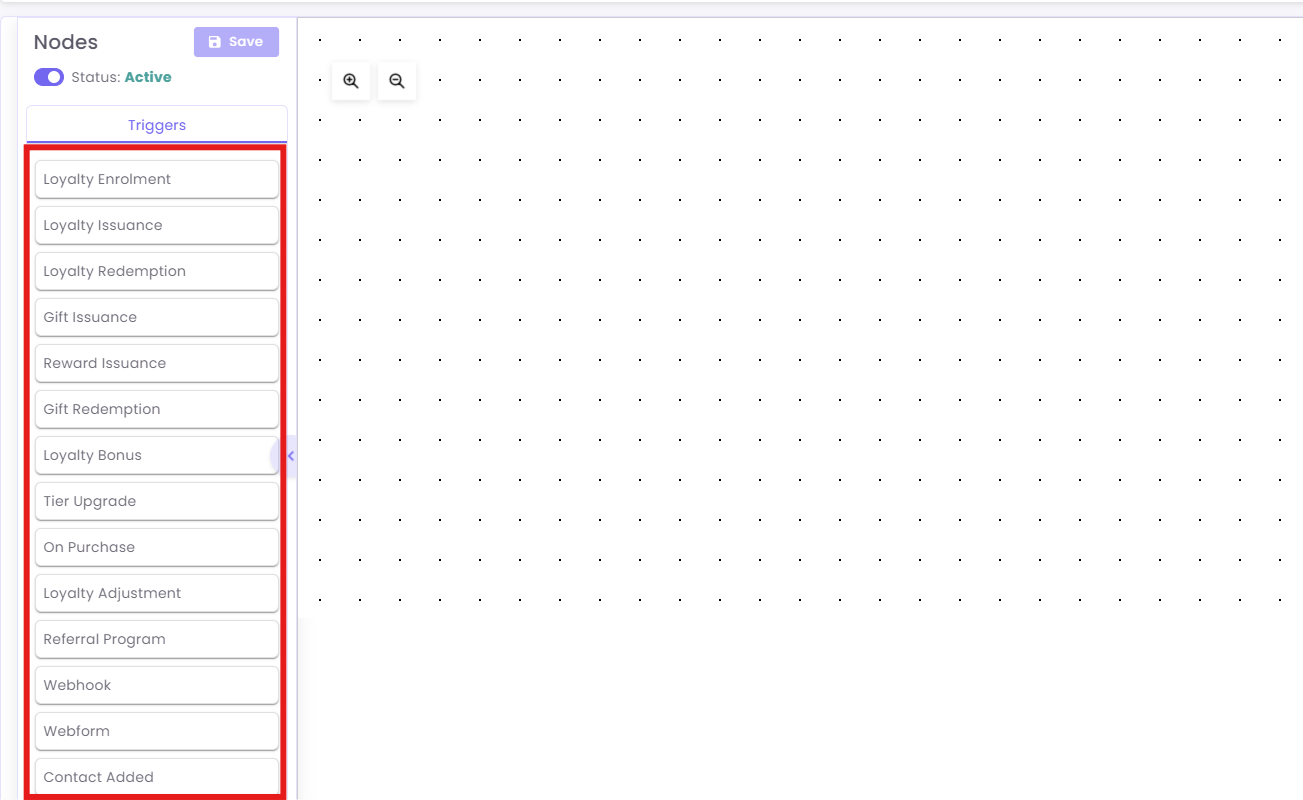
- Loyalty Enrolment: Starts a flow when a customer first signs up for your loyalty program.
- Loyalty Issuance: Triggers when loyalty points are given to a customer, typically after a purchase.
- Loyalty Redemption: Triggers when a customer spends their loyalty points to claim a reward.
- Gift Issuance: Starts a flow when a gift card is purchased and issued to a customer.
- Reward Issuance: Triggers when a specific, non-point reward (like a coupon) is given to a customer.
- Gift Redemption: Triggers when a customer uses a gift card to make a payment.
- Loyalty Bonus: Starts a flow when a customer receives bonus points outside of a standard purchase (e.g., for a birthday).
- Tier Upgrade: Triggers the moment a customer earns enough to move up to a new loyalty tier (e.g., from Silver to Gold).
- On Purchase: Starts a flow whenever any customer completes a purchase transaction.
- Loyalty Adjustment: Triggers when a staff member manually adds or removes points from a customer's account.
- Referral Program: Starts a flow when a customer successfully refers a friend who signs up or makes a purchase.
- Webhook: An advanced trigger that starts a flow when an external system (like your website) sends a signal to OptCulture.
- Webform: Triggers when a customer submits a specific OptCulture-hosted webform (like a "Contact Us" form).
- Contact Added: A general trigger that starts a flow when any new contact is added to your database, regardless of the source.
Step 4: Add and Connect Action Nodes
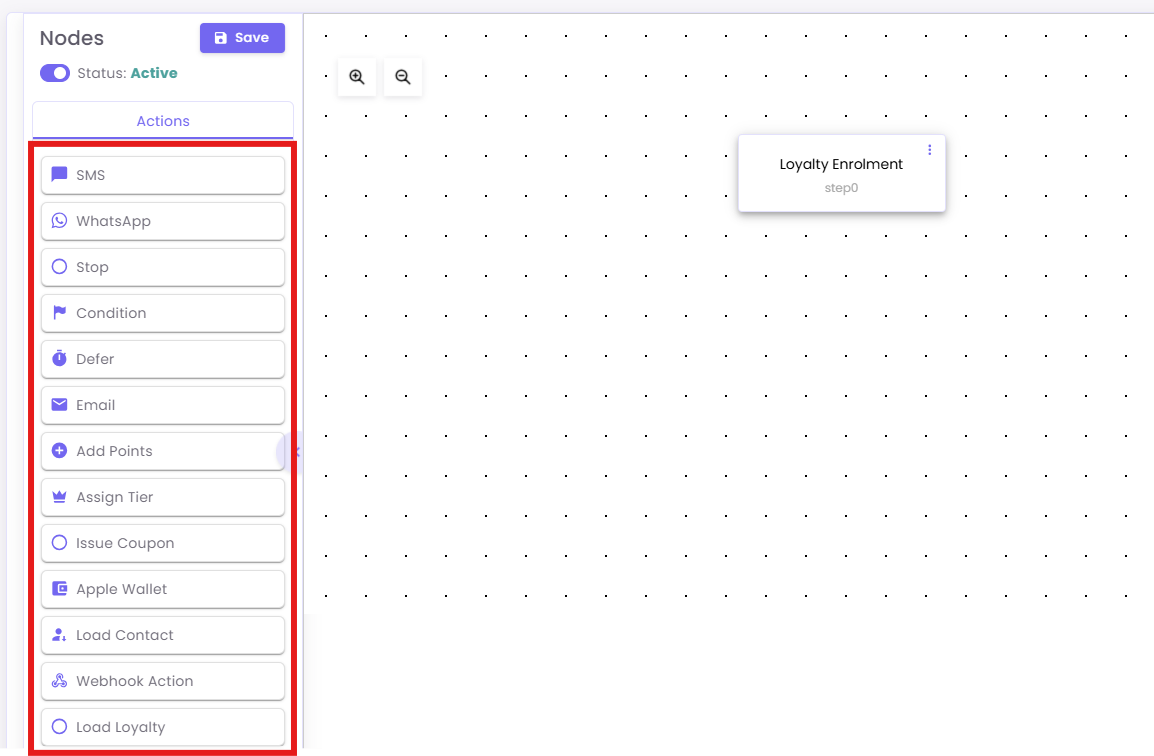
Next, you will build the journey using "Action" nodes.
-
Click the Actions tab on the "Nodes" panel (left).
-
Drag your desired action (e.g.,
Defer,Condition,Email) onto the canvas. -
To connect nodes, click and drag from the small circle on the bottom of one node to the small circle on the top of the next node.
Step 5: Configure Your Nodes
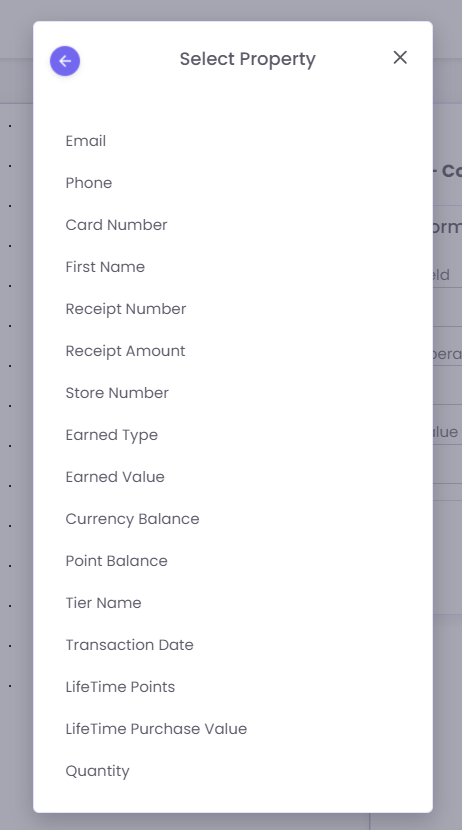
This is the most important step. You must click on each node you add to open the Configuration Panel on the right and set it up.
-
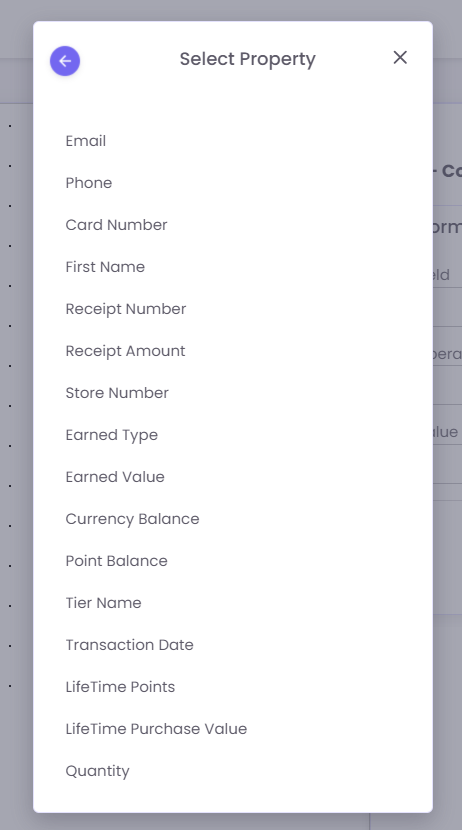
Email: The customer's email address, used for identification and email communications.
-
Phone: The customer's mobile phone number, used for identification and SMS communications.
-
Card Number: The unique identification number for the customer's loyalty or membership card.
-
First Name: The customer's first name, used for personalization.
-
Receipt Number: The unique identifier for a specific sales transaction receipt.
-
Receipt Amount: The total monetary value of a customer's transaction (purchase).
-
Store Number: The unique ID for the store location where a transaction or event occurred.
-
Earned Type: The category of points or currency earned (e.g., "Purchase," "Bonus").
-
Earned Value: The specific number of points or currency earned in a single transaction.
-
Currency Balance: The total amount of spendable, non-point currency (like a gift card balance) a customer has.
-
Point Balance: The total number of spendable loyalty points a customer currently has.
-
Tier Name: The name of the customer's current loyalty tier (e.g., "Silver," "Gold," "Platinum").
-
Transaction Date: The date (and time) a specific purchase or event occurred.
-
LifeTime Points: The cumulative total of all points a customer has ever earned.
-
LifeTime Purchase Value: The cumulative total monetary value of all purchases a customer has ever made.
-
Quantity: The number of items or units involved in a transaction.
Example A: Configuring a 'Defer' (Wait) Node
This node pauses the flow for a set time.
-
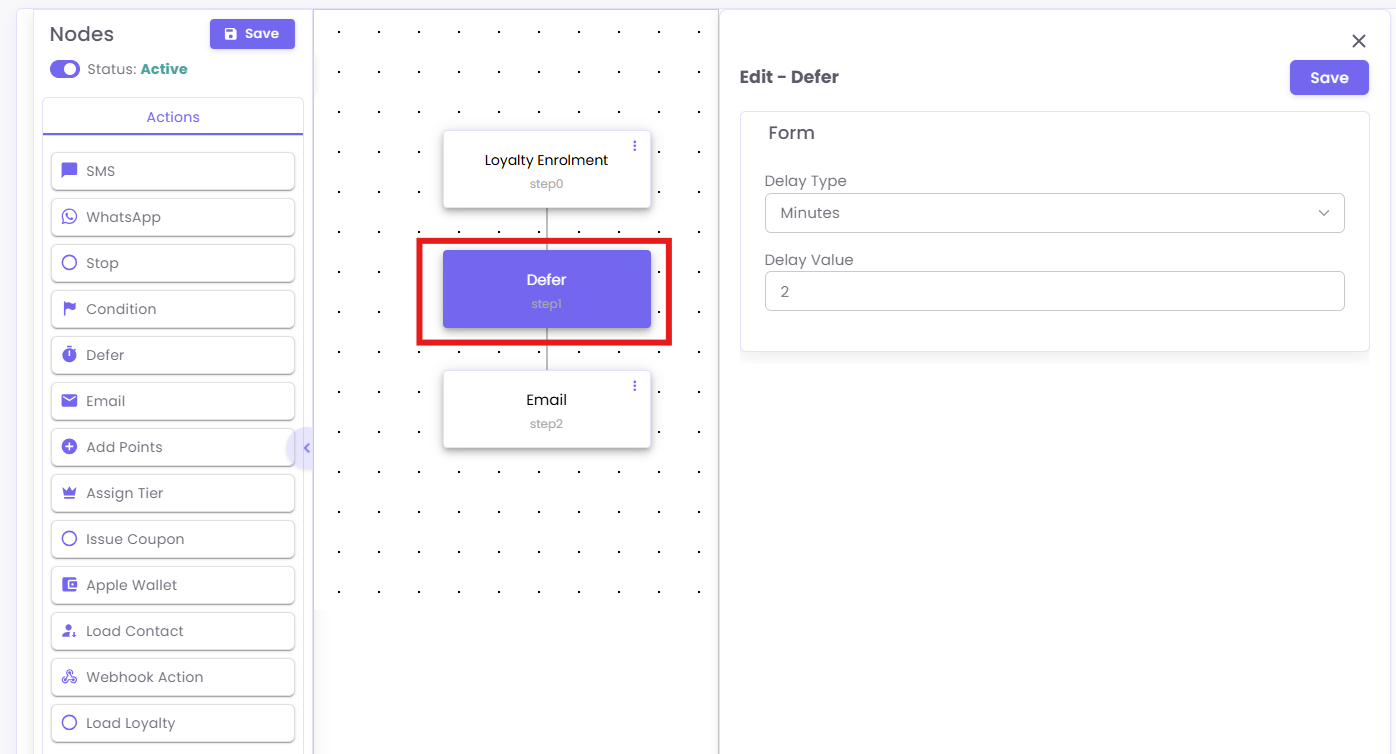
Drag the Defer node onto your canvas and connect it.
-
Click the
Defernode. The "Edit - Defer" panel will open. -
Set the Delay Type (e.g., Minutes, Hours, Days) and Delay Value (e.g., 2).
Example B: Configuring an 'Email' Node
-
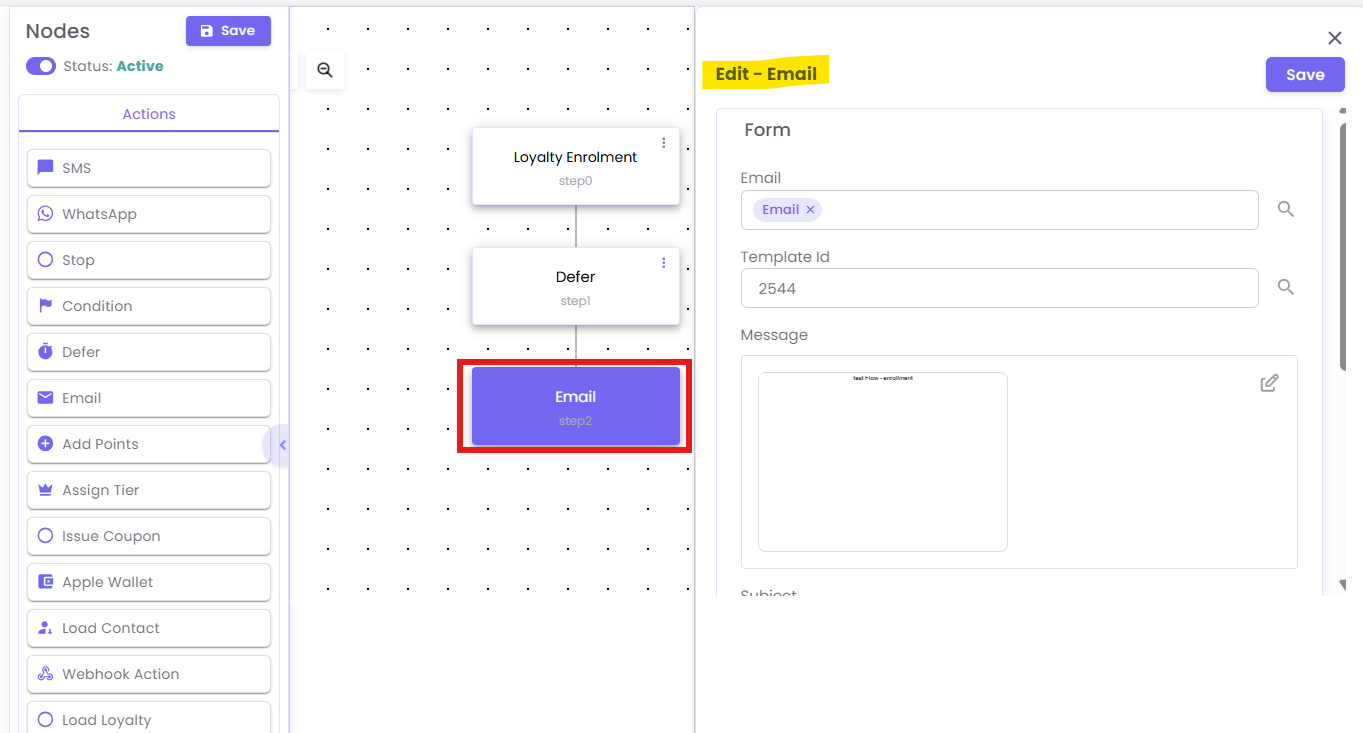
Drag the Email node onto your canvas and connect it.
-
Click the
Emailnode. The "Edit - Email" panel will open. -
Enter the
Template Idfor the email you want to send and fill in other required fields.
Example C: Configuring a 'Condition' (Branching) Node
This is the most powerful node. It creates a "Yes" / "No" branch.
-
Drag the Condition node onto your canvas and connect it.
-
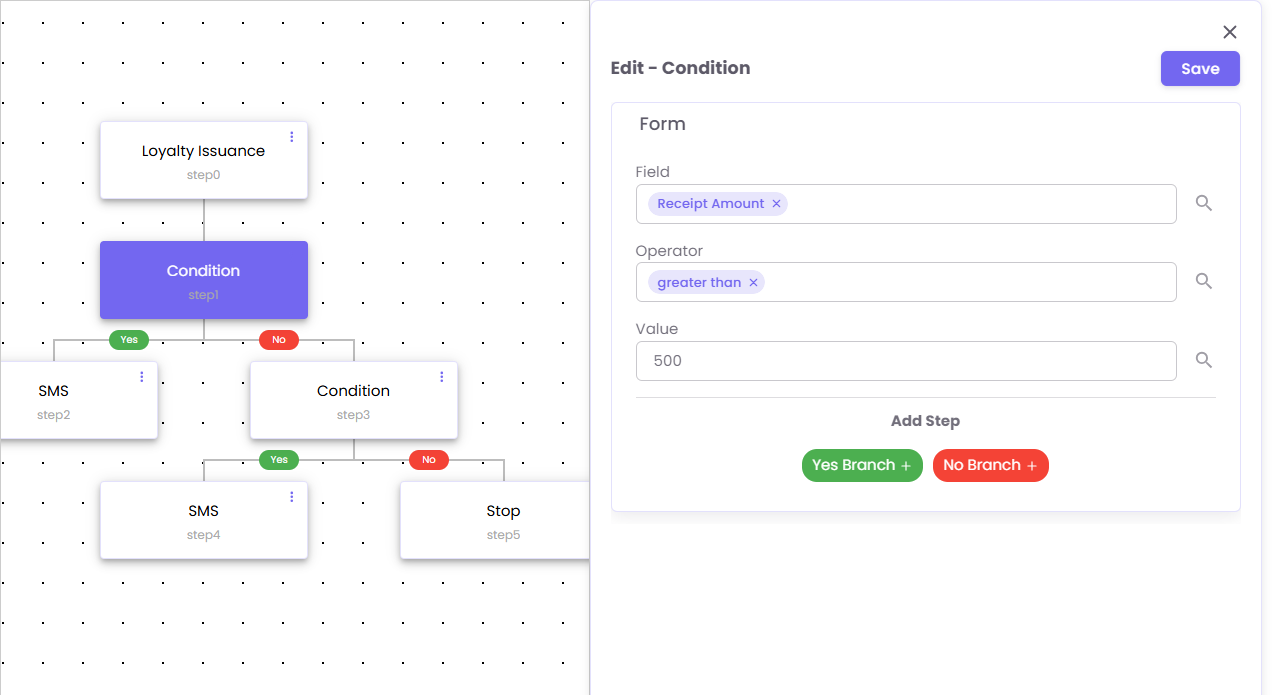
Click the
Conditionnode. The "Edit - Condition" panel will open. -
Field: Click the search box to select the property you want to check.
- Operator: Select how to compare the field (e.g.,
greater than,equals,less than). - Value: Enter the value to check against (e.g.,
500).
Step 6: Build Your Logic (Yes/No Branches)
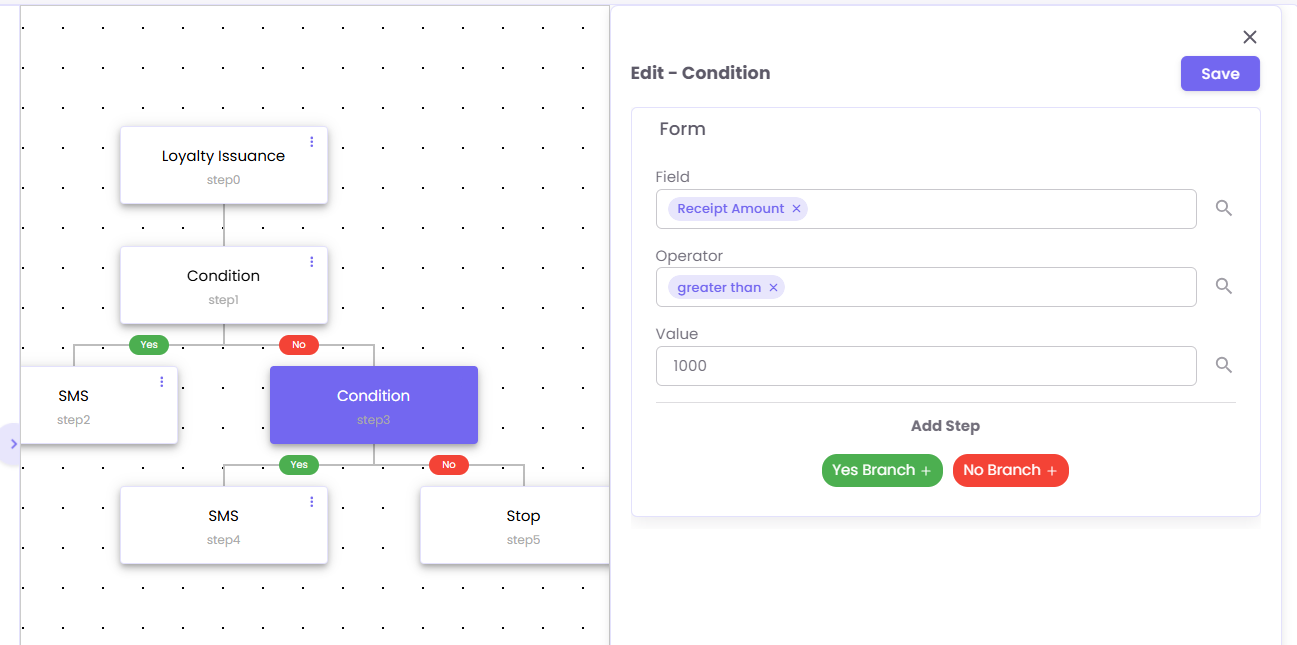
The Condition node will now show a green "Yes" branch and a red "No" branch. You must add actions to both paths, even if it's just a Stop node.
See the example flow below:
-
Trigger:
Loyalty Issuance(a purchase is made). -
Step 1 (Condition): Is
Receipt Amountgreater than500? -
Yes Branch (step2): Send
SMS(e.g., a "high-value customer" thank you). -
No Branch (step3): Check another
Condition. for greater than 1000
Step 7: Save and Activate Your Flow
Your flow is not "live" until you activate it.
-
Click the Save button in the top-left corner.
-
Click the Status toggle to switch it from
InActive
Your flow is now running and will process all new customers who meet the trigger.