Key Capabilities
-
Behavior-Based Grouping: Define customer similarity using two or more behavioral metrics (e.g., total spend, order frequency, average order value). Customers with similar statistical metrics land in the same cluster.
-
Audience Scoping (Customer Filters): Apply
ANDorORlogical conditions to narrow down eligible customers prior to clustering (e.g., limit analysis to customers with high visit frequencies or specific RFM categories). You can also leave filters blank to run the analysis across your entire database. -
Configurable Cluster Size: Granularity ranges from 2 to 50 distinct groups. Smaller cluster sizes create broad persona profiles, while larger cluster sizes generate targeted micro-segments.
-
Product Affinity Analysis: Evaluate co-purchase behaviors at the Category, Class, Subclass, or Department level. Reports automatically display primary, secondary, and tertiary product affinity patterns for each discovered group.
-
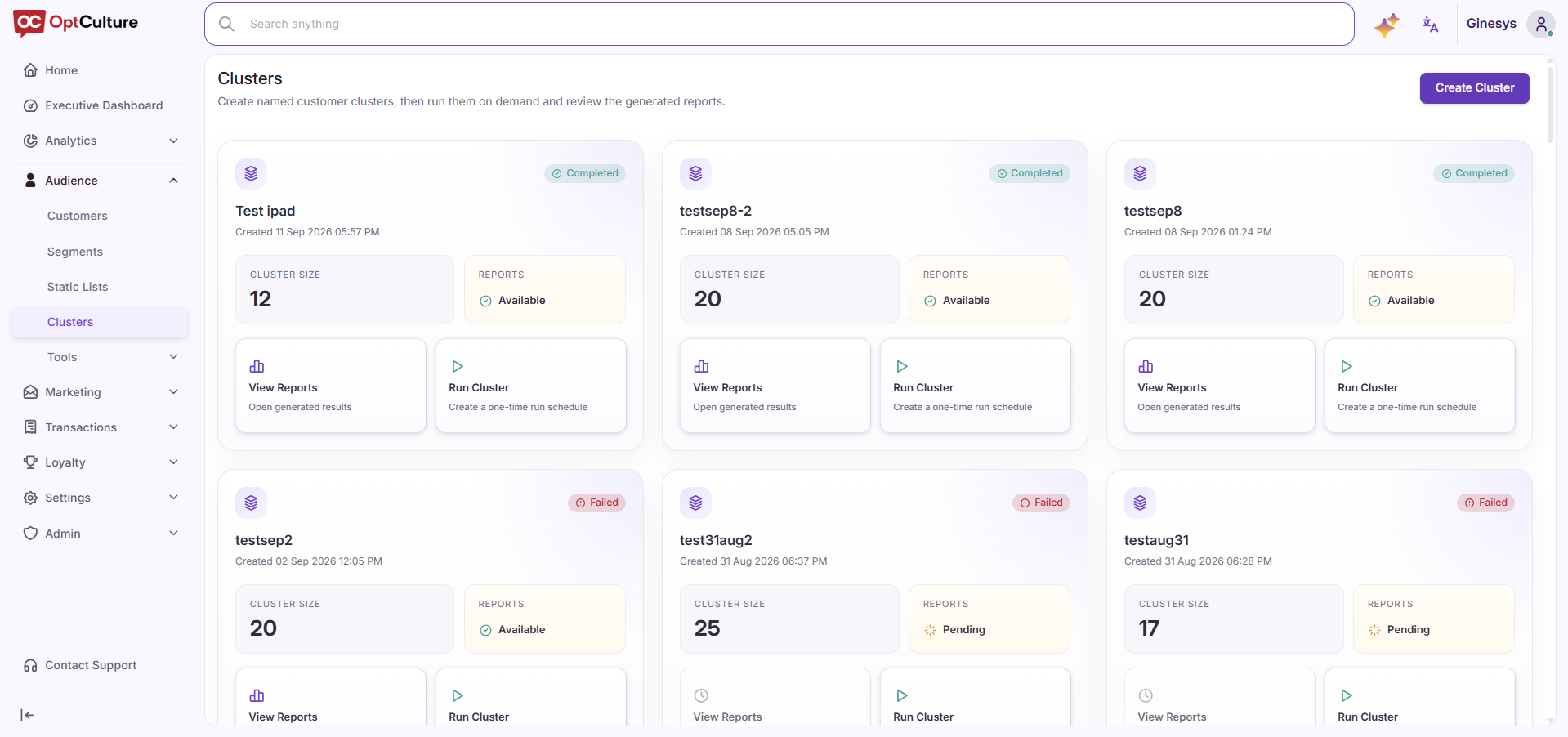
Interactive Reports & Visuals: Review completed cluster outputs via detailed data tables and visual scatter plots to compare relative cluster sizes and core metrics.